The short answer
If you're going to the Sahara from Marrakech, the 3-day/2-night tour is the one that's actually worth it — and the 2-day is the false economy. The Erg Chebbi dunes near Merzouga are about 570 km from Marrakech, a 9–10 hour drive each way over the High Atlas. There's no shortcut: that distance is fixed whichever tour you pick. The only real question is how much of your trip you spend staring at it through a car window.
The 2-day tour answers that question badly — it drives nine hours out, gives you one short night in the desert, and drives nine hours back, so the headline "Sahara tour" is mostly a coach seat. The third day is what fixes it: it breaks the journey with a night in the gorge and kasbah country, leaves time to actually see Aït Benhaddou and the Dadès and Todgha gorges, and turns the drive from a chore into one of the best road trips in Morocco. For not much more money, it's a completely different experience.
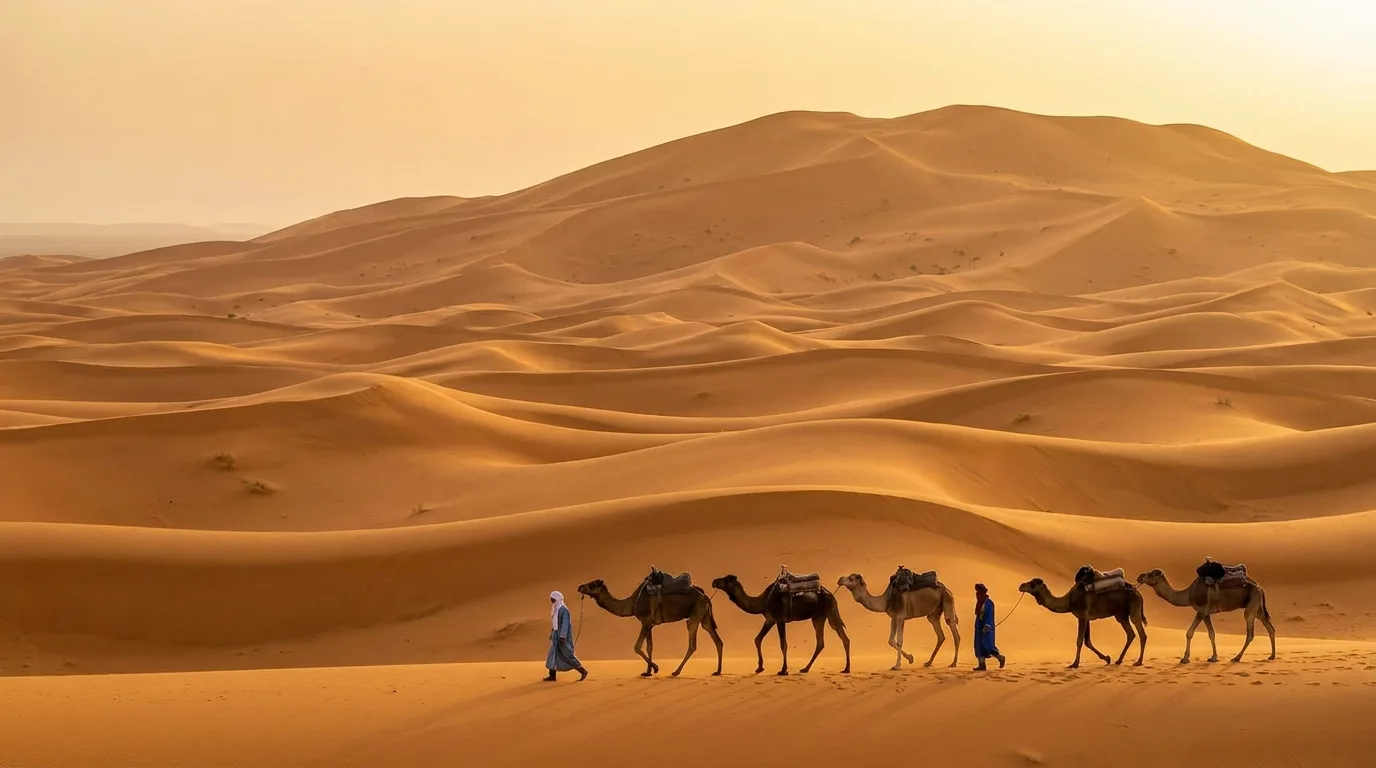
2-day vs 3-day — the real difference
This is the decision the whole thing turns on. Here's the honest comparison:
| 2-day / 1-night | 3-day / 2-night | |
|---|---|---|
| Driving | ~9–10 hrs out, ~9–10 hrs back — close to 20 hours total in two days | The same distance, but split across three days so it never feels punishing |
| Desert time | One night, arriving tired | One night, arriving relaxed — plus a night in the gorges |
| The famous stops | Aït Benhaddou and the gorges are rushed or seen only from the road | Time to actually walk Aït Benhaddou and the Todgha/Dadès gorges |
| Pace | Exhausting; the drive dominates | Balanced; the drive becomes part of the trip |
| Cost | Lower | Modestly higher — usually the better value per hour of actual experience |
Put simply: the 2-day costs you less money and a lot more comfort; the 3-day costs a little more and gives you the version people remember. Unless your schedule genuinely can't spare the day, the 3-day wins.
What the 3 days actually look like
A typical 3-day/2-night tour from Marrakech runs roughly like this (it can finish back in Marrakech or, smarter still, one-way in Fes):
| Day | The route |
|---|---|
| Day 1 | Marrakech over the Tizi n'Tichka pass (2,260 m), a stop at the UNESCO kasbah of Aït Benhaddou, on through Ouarzazate and into the Dadès Valley — overnight in a kasbah or hotel in the gorge country. |
| Day 2 | The Todgha Gorge and the Dadès bends in the morning, then east through the Drâa Valley palm groves to Merzouga. A late-afternoon camel trek (1.5–2 hours) into the Erg Chebbi dunes to reach camp at sunset — dinner, music, and a night under the stars. |
| Day 3 | Sunrise over the dunes (the highlight of the whole trip), the camel ride back at dawn, then the long drive back to Marrakech — or onward to Fes if you've booked the one-way option. |
Why the drive is the point
The thing first-timers underestimate is that the journey to Merzouga is genuinely spectacular — on a 3-day tour it stops being "transit" and becomes a highlight. Between Marrakech and the dunes you cross:
- The Tizi n'Tichka pass — the dramatic 2,260 m crossing of the High Atlas.
- Aït Benhaddou — the UNESCO-listed fortified earthen kasbah, one of Morocco's most iconic sights (and a famous film location).
- Ouarzazate — the "door of the desert" and home to Morocco's film studios.
- The Dadès and Todgha gorges — towering red-rock canyons that are a destination in themselves.
- The Drâa Valley — endless palm groves on the final run to Merzouga.
On the 2-day tour you blow past most of this. On the 3-day you get to stand in it. That's the whole argument.
What it costs
A 3-day/2-night private 4x4 tour from Marrakech with gorge stops typically runs around 2,000–3,000 MAD per person, depending on group size and the standard of desert camp. Shared minibus tours are cheaper; private vehicles and better camps cost more. The camps themselves range from budget (shared tents, basic facilities) through mid-range to genuine luxury (private en-suite tents) — the dunes, the silence and the stars are the same at every tier.
Who can skip the 3-day (or the trip entirely)
To be honest about it, the desert isn't right for every itinerary:
- If your schedule truly can't spare three days, the 2-day tour does technically get you to the dunes — just go in knowing it's a hard, drive-heavy trip.
- If you only have a few days in Morocco total, consider skipping the deep desert this time and using the days in Marrakech and the nearby Atlas instead — see how many days you need in Marrakech.
- If you're visiting both Marrakech and Fes, do the desert one-way between them rather than as a round trip — it removes a whole day of backtracking. Our Sahara & Atlas loop shows how the desert slots into a longer route.
For how the desert fits into trips of different lengths, see how many days you need in Morocco.
Best time to go
October to April is the season, with October–November the sweet spot — comfortable days, cool clear nights and the most photogenic dunes. Winter (December–February) is fine by day but the desert nights get genuinely cold, even to freezing, so pack a warm layer for camp. From May the heat climbs fast, and July–August is dangerously hot (45–50°C) — best avoided, when many camps close. The full month-by-month breakdown is in our Sahara trek guide.
The verdict
Yes — the 3-day Marrakech to Merzouga tour is worth it, and it's the right way to do the Sahara from Marrakech. The dunes of Erg Chebbi are one of the great experiences in Morocco, but they're a long way from Marrakech, and the difference between a good trip and a gruelling one comes down to that third day. It buys you a relaxed pace, the gorges and Aït Benhaddou as real stops rather than blurs, and a proper night and sunrise in the desert. The 2-day tour reaches the same sand but spends your holiday in a car to get there. If you can spare the day — and if you're seeing both cities, route it one-way to Fes — book the 3-day.
Ready for the detail? Our full Sahara camel trek guide covers the trek, the camps, what to pack and how to book, and the Sahara region guide sets the wider scene.
Frequently asked questions
Is a 3-day Marrakech to Merzouga tour worth it? +
Yes — if you're doing the Sahara from Marrakech, the 3-day/2-night tour is the version worth booking. Merzouga is ~570 km away (a 9–10 hour drive each way), so the 2-day tour spends almost all its time in the car for one short desert night. The third day turns the drive into the experience — real stops at Aït Benhaddou and the Dadès and Todgha gorges, a gentler pace, and a proper night and sunrise in the dunes. The extra day and cost are well spent.
What's the difference between the 2-day and 3-day tour? +
The 2-day/1-night tour drives Marrakech to Merzouga in one long day, does the camel trek and one desert night, then drives all the way back — roughly 20 hours of driving for one night. The 3-day/2-night version breaks the journey with a night in the gorge or kasbah country around Dadès or Todgha, leaving time to actually see Aït Benhaddou and the gorges, before the dunes on day two and the return (or onward to Fes) on day three. The 3-day is far less rushed for not much more money.
How much does a 3-day Merzouga tour cost? +
A 3-day/2-night private 4x4 tour from Marrakech with gorge stops typically runs around 2,000–3,000 MAD per person, depending on group size and camp standard. Shared minibus tours cost less. Be wary of the cheapest options — they cut corners on vehicle and camp quality and add commission-shop stops. A mid-range tour booked through your riad usually means a better vehicle, better camp and fewer upsell stops.
Should you do the Sahara from Marrakech or Fes? +
Both work, and on a 3-day tour the smartest option is often one-way: start in Marrakech, see the desert in the middle, finish in Fes (or the reverse), so you never repeat the long drive. The Marrakech approach is the more scenic — the Tizi n'Tichka pass, Aït Benhaddou and the gorges — while the Fes side is a bit more direct. If you're visiting both cities anyway, a one-way desert tour between them is the most efficient way to do it.
Is the long drive to Merzouga worth it? +
On a 3-day tour, yes — the drive is a highlight, not filler. The route crosses the Tizi n'Tichka pass (2,260 m), passes the UNESCO kasbah of Aït Benhaddou, the film town of Ouarzazate, the Drâa Valley palm groves and the Todgha and Dadès gorges. The third day's breathing room lets you stop and enjoy these. It's the 2-day tour, which treats the same road as pure transit, that makes the drive feel like a slog.
Can you visit Merzouga without a tour? +
Yes. You can self-drive — the roads are paved and well signed, about 9–10 hours from Marrakech via Ouarzazate — and book a camel trek and camp on arrival, which gives you full control of the pace. There's also a budget route by CTM bus to Errachidia (80 km away) plus a shared grand taxi, though that's a 12–14 hour journey. For most first-timers, a well-chosen 3-day organised tour is the easiest and most rewarding way to do it.