The short answer
Yes — Chefchaouen is worth visiting for most travellers. There is genuinely nowhere else like it in Morocco: an entire medina painted in every shade of blue, climbing a hillside in the Rif mountains. It photographs beautifully and, unlike a lot of heavily Instagrammed places, it does not disappoint in person — being inside the blue streets is better than the pictures, not worse.
The honest qualifiers are about logistics and expectations, not the town itself. Chefchaouen is small, it is out of the way (no train, no airport), and the central alleys get busy with day-trippers in the middle of the day. None of that ruins it — but it does shape how long you should stay and when you should explore. The travellers who come away disappointed are almost always the ones who rushed it in a crowded midday hour; the ones who stayed a night and walked the medina at dawn rarely regret the trip.
What makes it worth it
The blue medina is the real thing
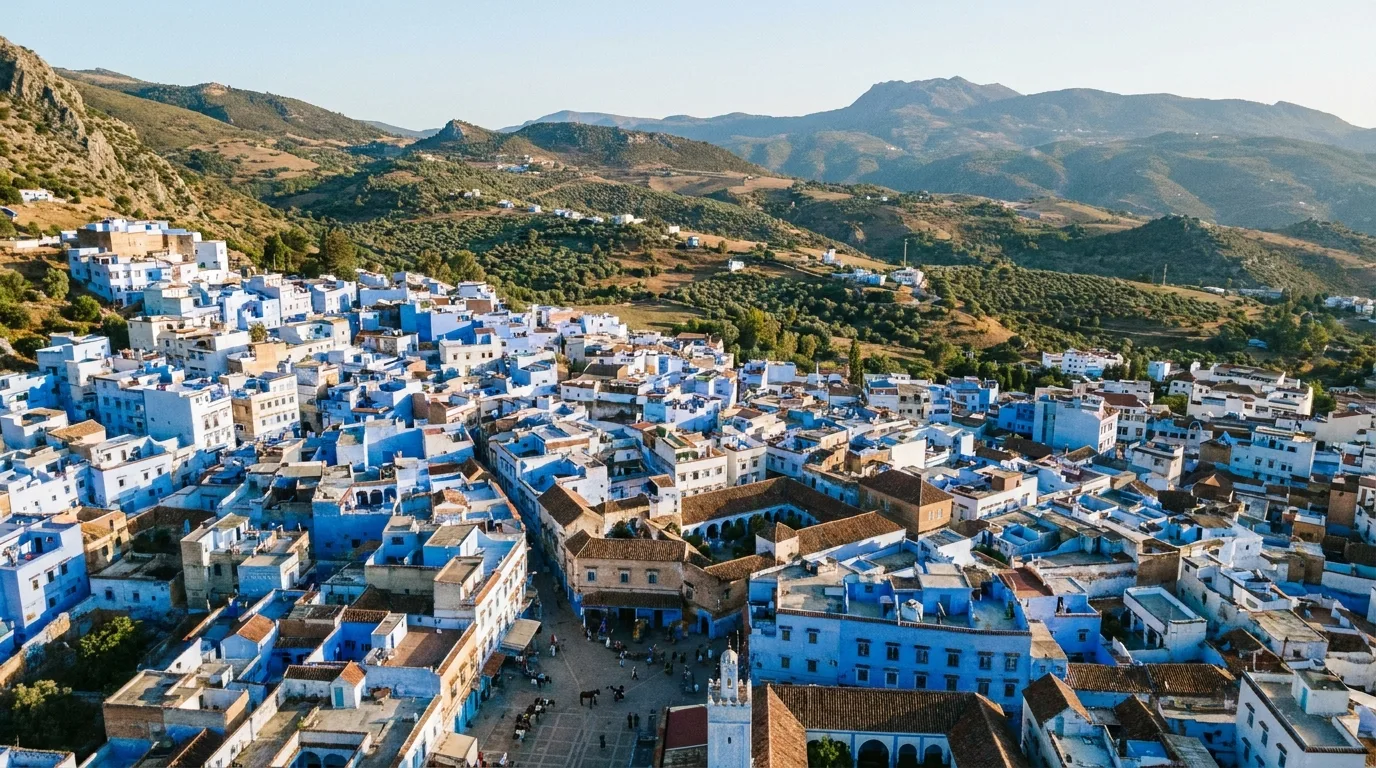
The reason to come is the medina, and it delivers. The old town is compact — roughly 600 metres end to end — and every surface is painted blue: walls, stepped streets, doorframes, flowerpots, all in shades from pale sky to deep indigo, set off with white trim and splashes of pink bougainvillea. It is the most photogenic town in Morocco by a wide margin, and the effect of being surrounded by it is genuinely disorienting in a good way. The blue is repainted regularly, so it stays vivid rather than faded.
The setting and the calm
Chefchaouen sits in a valley at around 600 metres, with the Rif mountains rising directly behind it — including Jebel El Kelaa (1,616 m) looming over the town. That mountain air makes it noticeably cooler and fresher than the coastal cities, and the whole place runs at a slower pace. The souks here are gentler than the relentless ones in Fes or Marrakech: sellers are present but not aggressive, and the goods reflect real local craft — Rif wool blankets and djellabas in red, white and black stripes, hand-woven baskets, and the town's distinctive blue ceramics.
It's an easy, low-stress place to wander
For travellers who find the big medinas overwhelming, Chefchaouen is a relief. You can let yourself get mildly lost — the town is small enough that you are never more than ten minutes from the central Place Uta el-Hammam, the tree-shaded main square with its restored kasbah and red-walled Grand Mosque. There is no real hustle, no maze of identical lanes, and the photogenic payoff is constant.
Real sights beyond the photos
It is not only a backdrop. A short, steep walk to the Spanish Mosque on the hill gives the classic elevated view over the whole blue valley at sunrise or sunset. The Ras el-Maa spring at the top edge of the medina is a genuinely tranquil spot where cold mountain water cascades over rock. And for active travellers, the half-day climb up Jebel El Kelaa or the Akchour waterfalls hike in nearby Talassemtane National Park turn a one-day stop into a proper two-day base.
The honest downsides
This site doesn't oversell places, so here is the other side of the ledger:
- It's genuinely out of the way. There is no train station and no airport. Reaching Chefchaouen means a bus or a car: roughly 2 hours from Tangier, about 3 to 3.5 hours from Fes, and 4–5+ hours from Rabat or Casablanca. That isolation is part of what keeps it unspoiled, but it does cost you travel time.
- It's small. The thing that makes it relaxing also means you can see the headline sights in a day. If you are expecting a city's worth of monuments and museums, that is not what Chefchaouen is — its appeal is atmosphere, not a long checklist.
- The middle of the day gets crowded. Day-trip coaches from Tangier and Fes fill the main square and the most famous alleys from late morning to mid-afternoon, especially in summer. The photos you've seen of empty blue streets were almost all taken at dawn.
- Photography etiquette matters. Residents are generally tolerant but not universally happy to be photographed — always ask first, particularly with women, and some people in the busiest spots will expect a small tip for posing.
- The Rif's reputation. The surrounding region is known for cannabis cultivation, and solo travellers may occasionally get informal offers. It is easily and safely declined with a polite no; it does not make the town unsafe, but it is worth knowing in advance.
Who should go — and who can skip it
Go if you love photography, mountain scenery, and slow, low-pressure wandering; if the intensity of Fes or Marrakech wears you out and you want a gentler counterpoint; or if you're travelling through the north anyway between Tangier and Fes, where Chefchaouen slots in naturally.
You can skip it if your trip is short (under a week) and packed with must-see cities, and the long detour into the Rif would cost you a day you can't spare. In that case, prioritise the imperial cities and the desert, and save the Blue City for a return trip. It is a highlight, but it is not the one sight in Morocco you cannot miss — and forcing it into a rushed itinerary is the surest way to come away underwhelmed.
How long should you stay?
| Length of stay | What you get |
|---|---|
| Half day / day trip | The medina, main square and a meal — but in the busiest hours, and a lot of driving for the time on the ground. |
| One night (ideal) | The medina in the evening and at dawn without crowds — the version of Chefchaouen worth coming for. |
| Two nights | Adds the Jebel El Kelaa hike or the Akchour waterfalls, plus a slower, more local rhythm. |
| Three+ nights | Only for travellers deliberately slowing down — pleasant, but you'll have seen the town by then. |
For most people the answer is one night. It is the difference between ticking off a blue street for a photo and actually experiencing the place.
Best time to visit
March–May and September–November are the sweet spots: mild mountain temperatures (around 15–22°C), clear skies and the most photogenic light. Summer is warm (25–28°C) and busiest — the medina at midday in July is genuinely crowded. Winter is cool and sometimes misty, which gives the blue city a quieter, more mysterious feel; bring a warm layer, because at 600 metres the evenings are cool even in summer.
The verdict
Chefchaouen is worth visiting — and it's worth doing properly. Don't squeeze it into a single crowded midday hour and judge it on that. Get there, stay a night, walk the blue medina at dawn, climb to the Spanish Mosque for the view, eat a slow rooftop breakfast, and let the pace of the Rif do its work. Do that and it earns its reputation. Treat it as a drive-by photo stop and you'll wonder what the fuss was about.
Ready to plan it for real? Our full Chefchaouen travel guide covers the medina, the sights, where to eat and stay, and exactly how to get there.
Frequently asked questions
Is Chefchaouen worth visiting? +
Yes — for most travellers Chefchaouen is worth the trip. The blue-washed medina is genuinely unlike anywhere else in Morocco, the mountain setting is beautiful, and the pace is calmer and the souks gentler than Fes or Marrakech. The main caveats are that it is out of the way (no train, no airport) and small, so a day or a single night is enough for many people.
How many days do you need in Chefchaouen? +
One full day covers the medina, the main sights and a meal, but staying one night is the sweet spot — you get the town in the evening and at dawn without the day-trip crowds. Two nights lets you add the Jebel El Kelaa hike or the Akchour waterfalls.
Is Chefchaouen worth it as a day trip from Fes? +
It is possible but long — Fes to Chefchaouen is about 3 to 3.5 hours each way, so a day trip means 6–7 hours of driving for a few hours in town. Staying at least one night is far better value for the travel time, and many visitors fold it into a northern route between Fes and Tangier instead.
Why is Chefchaouen painted blue? +
There is no single confirmed reason. The most common explanation is that the town's Jewish community began painting walls blue to symbolise the sky and heaven, a tradition maintained and expanded over the 20th century. Other accounts link it to keeping mosquitoes away or simply to custom and tourism. The blue is repainted regularly and is now central to the town's identity.
Is Chefchaouen too touristy? +
The main square and the most photogenic alleys get busy with day-trip coaches from late morning to mid-afternoon, especially in summer. But the crowds thin dramatically early and late in the day, and the upper and outer medina stays quiet. Explore at 7–9am or after 4pm and it feels calm and lived-in.
Is Chefchaouen safe for tourists? +
Chefchaouen is generally very safe and relaxed, with a gentler feel than the big cities, and the medina is small enough that getting lost is harmless. Normal precautions apply: watch your belongings in busy areas, ask before photographing people, and politely decline any informal cannabis offers from strangers in the wider Rif region.