The short answer
Yes — Casablanca is worth visiting, but for a day rather than a week. This is the part of Morocco that catches a lot of first-time visitors off guard: Casablanca is not an ancient imperial city of palaces and labyrinthine souks. It is the country's modern commercial engine — a sprawling Atlantic port of four million people, more business than fairy tale. If you arrive expecting a bigger Marrakech, you'll be disappointed.
Judge it for what it actually is, though, and a day here is genuinely rewarding. The Hassan II Mosque is one of the most extraordinary buildings on earth and reason enough to stop on its own. Add the finest Art Deco streetscape in Africa, a breezy Atlantic corniche, and the most varied food scene in the country, and Casablanca earns its day. The mistake isn't visiting — it's allotting it three days you should have spent in Fes or the desert.
What makes it worth it
The Hassan II Mosque is world-class
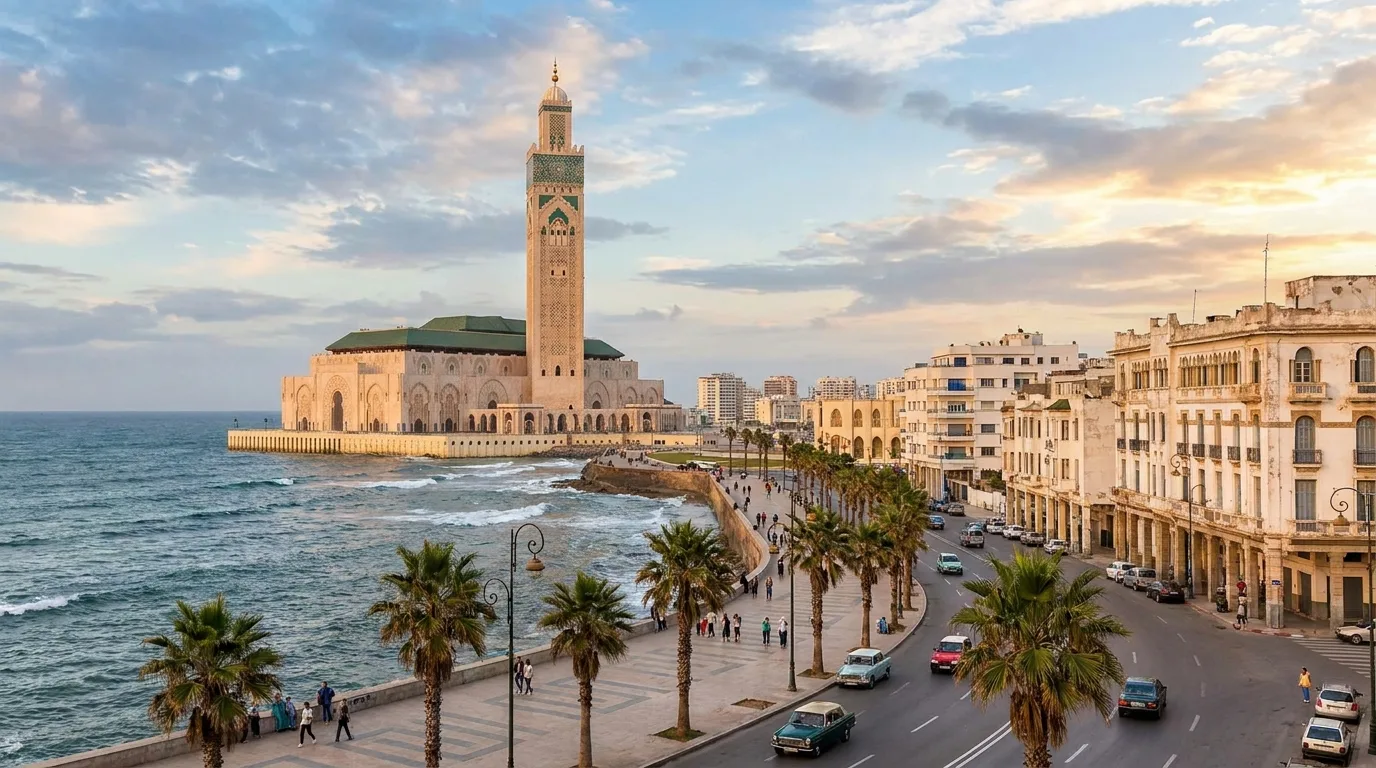
If you see one thing in Casablanca, see this. Completed in 1993 on a promontory built out over the Atlantic, the Hassan II Mosque has the tallest minaret in the world at 210 metres and can hold 105,000 worshippers inside and on its esplanade. On clear days the ocean is visible through a glass floor in the prayer hall. Crucially — and unusually for Morocco — non-Muslims are allowed inside on guided tours, so you can actually experience the carved cedar, Italian marble and hand-laid zellige up close. It is not a quick photo stop; it's the genuine article.
The best Art Deco in Africa
Casablanca was a small fishing village until the French rebuilt it in the early 20th century, and what they left behind is one of the world's great collections of Art Deco architecture. Walk Boulevard Mohammed V and the streets around it and you pass white facade after white facade of curved balconies, wrought iron and tiled archways. The 1930 Cathédrale du Sacré-Cœur and the bustling Marché Central are easy highlights. It's a side of Morocco you won't see anywhere else in the country.
The corniche and the food
The Ain Diab Corniche is where the city exhales — several kilometres of Atlantic seafront lined with cafés, beach clubs and seafood restaurants, best in the evening from May to October. And thanks to its size and cosmopolitan population, Casablanca has the most diverse dining in Morocco: superb fresh Atlantic seafood at prices well below Europe, plus everything from traditional courtyard restaurants in the old medina to upscale French, Japanese and Lebanese kitchens.
It's the gateway, so you're here anyway
Mohammed V International Airport (CMN) is the busiest in Morocco, and the city is the hub of the national rail network — Rabat is 45 minutes away, Marrakech around 2h 20min, Tangier 2h 15min on the high-speed Al Boraq, and Fes about 4h 30min. Most Morocco trips begin or end in Casablanca whether you plan it or not, which makes spending a day here the easy, efficient choice rather than a detour.
The honest downsides
This site doesn't oversell places, so here's the other side of the ledger:
- No grand old medina. Casablanca's old medina is small, low-key and workaday — pleasant for an hour, but nothing like the labyrinths of Fes or Marrakech. If atmospheric ancient streets are what you came to Morocco for, this isn't the city that delivers them.
- It's big, busy and modern. This is a working metropolis of four million, with traffic, sprawl and commercial energy to match. That's exactly its character, but it means less of the storybook Morocco and more of a real, fast-moving city.
- The headline sights are quickly covered. Beyond the mosque, the Art Deco centre and the corniche, there isn't a long checklist. That's why a day works and three days drag.
- The Atlantic isn't a beach holiday. The corniche is great for a stroll and a meal, but the ocean here has a strong undertow and the water is cool — this is a city seafront, not a swimming resort.
Who should go — and who can skip it
Go if you're flying in or out of Casablanca anyway (most people are), if the Hassan II Mosque is on your list, or if you enjoy architecture, big-city food and a more modern, cosmopolitan side of Morocco. A day here is a natural, low-effort addition to almost any itinerary.
You can skip a long stay if your time is tight and you've come for old medinas, souks and desert landscapes — in that case give Casablanca a single day or even just an airport-to-station transit, and spend your nights in Marrakech, Fes or Chefchaouen instead. The one thing worth not skipping, even on a transit day, is the mosque.
How long should you stay?
| Length of stay | What you get |
|---|---|
| Transit only | Time for the Hassan II Mosque between the airport and the train — the bare minimum, but it captures the one unmissable sight. |
| One day / one night (ideal) | The mosque, the Art Deco centre, the old medina and a corniche dinner — the full city without padding. |
| Two days | Adds a slower pace and an easy day trip to Rabat, 45 minutes away by train. |
| Three+ days | Only if Casablanca is your work or family base — you'll have seen the highlights well before then. |
For most travellers the answer is one day. It's enough to do Casablanca justice without borrowing time from the places that are the real reason you came to Morocco.
Best time to visit
March–May and September–November are ideal: warm, clear days and comfortable evenings. Summer (25–30°C) is busy but the Atlantic breeze keeps it bearable, and the corniche is at its liveliest from May to October. Winter is mild but can be grey, wet and windy off the ocean — bring a layer even when it looks sunny, because the sea wind here is sharp.
The verdict
Casablanca is worth visiting — for a day, on its own terms. Don't come expecting the medieval Morocco of postcards, and don't sacrifice nights in Fes or the desert to linger here. Do come for the Hassan II Mosque, which is genuinely world-class, and enjoy the Art Deco streets, the seafood and the Atlantic air as a bonus. Used as the gateway it naturally is — first day in, last evening out — Casablanca is a smart, rewarding part of a Morocco trip. Asked to carry three days as a destination in its own right, it strains.
Ready to plan it for real? Our full Casablanca travel guide covers the mosque, the Art Deco centre, where to eat and stay, and exactly how to get around.
Frequently asked questions
Is Casablanca worth visiting? +
Yes — for a day or two. It's a modern commercial city rather than an imperial one, so it has fewer historic sights than Marrakech or Fes. But the Hassan II Mosque is one of the most spectacular buildings in the world and reason enough on its own, and the Art Deco centre and Atlantic corniche fill a pleasant day. Most travellers use it as an arrival or departure base.
How many days do you need in Casablanca? +
One full day covers the highlights: a guided tour of the Hassan II Mosque, the Art Deco city centre, the old medina, and the Ain Diab corniche for the evening. A second day lets you slow down or take an easy 45-minute train day trip to Rabat. Few travellers need more than two nights.
Is Casablanca better than Marrakech? +
They're very different. Marrakech is the classic Moroccan experience — a labyrinthine medina, souks and palaces — and the better choice for a first trip. Casablanca is bigger, more modern and more cosmopolitan, with world-class Art Deco and the Hassan II Mosque but far less old-city atmosphere. Most itineraries include both. We compare cities in Fes vs Marrakech.
Is the Hassan II Mosque worth it? +
Yes — it's the single best reason to stop in Casablanca. Completed in 1993 on a promontory over the Atlantic, it has the world's tallest minaret at 210 metres and room for 105,000 worshippers. Unusually for Morocco, non-Muslims can go inside on guided tours, and the carved cedar, marble and zellige interior is extraordinary. Visit at sunset for the best light.
Is Casablanca safe for tourists? +
Casablanca is generally safe and, in the old medina, noticeably less hassle-prone than Marrakech. As in any large city, stay aware in crowded areas and around transport hubs, use the meter in petits taxis, and keep an eye on belongings. The tramway and ride-hailing apps make getting around easy and low-stress.
Is Casablanca worth visiting for the 2030 World Cup? +
Yes — Casablanca is Morocco's flagship host city for the 2030 FIFA World Cup, and the new Grand Stade Hassan II is set to be one of the largest stadiums in the world. As the country's main airport and rail hub it will be a natural base for matches, so demand for rooms will be very high — book 12–18 months ahead for match weeks. See our Casablanca stadium guide.